Introduction
With the 2025 tax changes approaching, financial planning is more important than ever. This guide offers five essential strategies for 2025 tax changes financial planning to secure your future. These updates could significantly impact your taxes, savings, and investments. In this guide, we’ll explore five essential strategies to help you adjust your financial plan for 2025 tax changes and ensure you’re prepared for what’s ahead. Whether you’re new to financial planning or looking to refine your approach, these tips will set you on the right path.
Note: This article is for educational purposes only and does not constitute financial advice. Always consult a qualified professional for personalized guidance.
1. Understand the New Tax Brackets and Rates
The 2025 tax changes introduce revised tax brackets and rates, which could affect how much of your income is taxed. For example, the 22% tax bracket now applies to single filers with incomes up to $100,000, up from $95,000 in 2024. To adjust your financial plan for 2025 tax changes, review your current withholdings or estimated tax payments. If you’re close to a bracket threshold, consider deferring income or accelerating deductions to minimize your tax liability. Not sure what a tax bracket is? It’s the range of income taxed at a specific rate—understanding this is key to effective financial planning.

2. Maximize Your Retirement Contributions
One of the most effective ways to reduce your taxable income is by maximizing contributions to retirement accounts. In 2025, the contribution limits for 401(k)s have increased to $22,000, and IRA limits are now $7,500. By contributing the maximum amount, you not only lower your taxable income but also build a nest egg for the future. If you’re over 50, take advantage of catch-up contributions—$7,500 for 401(k)s and $1,000 for IRAs. Adjusting your financial plan for 2025 tax changes means making the most of these tax-advantaged accounts. For more details, visit the IRS Retirement Planning Resources.
Additional Notes
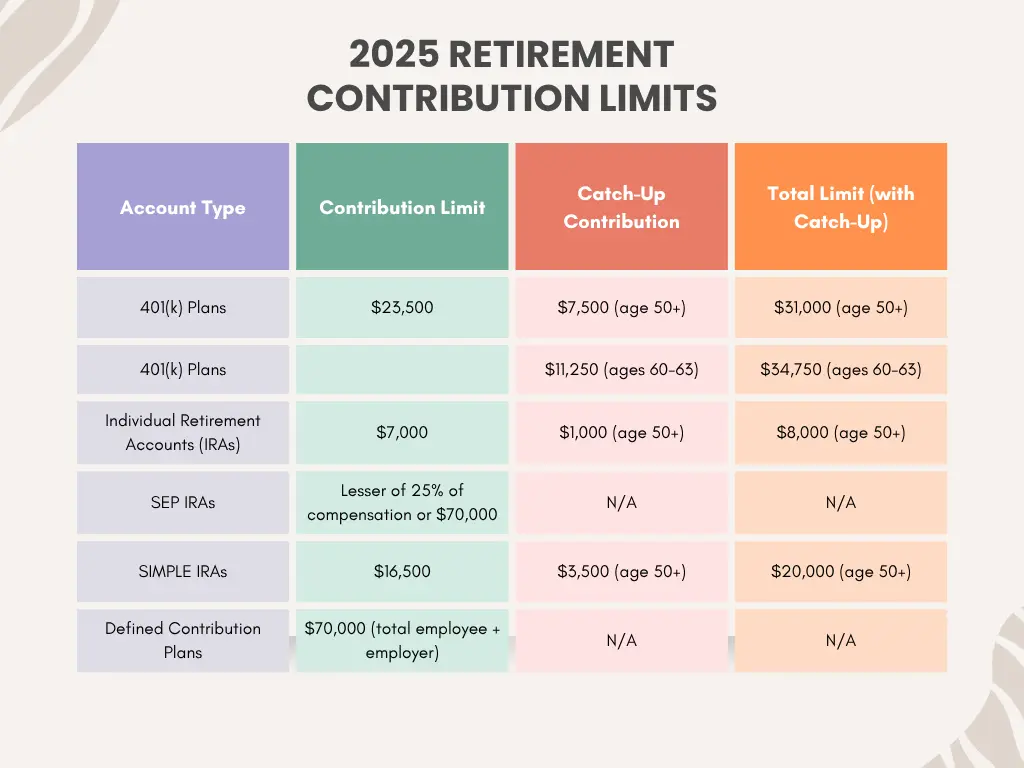
- 401(k) Plans:
- Standard limit: $23,500.
- Catch-up contribution: $7,500 for age 50+; $11,250 for ages 60-63.
- IRAs:
- Applies to both Traditional and Roth IRAs.
- Catch-up of $1,000 for age 50+.
- SEP IRAs:
- Limit is the lesser of 25% of compensation or $70,000.
- SIMPLE IRAs:
- Catch-up of $3,500 for age 50+.
- Defined Contribution Plans:
- Total limit includes both employee and employer contributions.
Important: These limits may adjust due to inflation or policy changes. Verify with IRS.gov or a financial advisor.
3. Leverage Tax-Advantaged Accounts
Tax-advantaged accounts like Health Savings Accounts (HSAs) and 529 plans offer additional ways to reduce your taxable income. In 2025, HSA contribution limits have increased to $4,000 for individuals, and 529 plans now cover a broader range of educational expenses. Incorporating these accounts into your financial plan for 2025 tax changes can help you save for healthcare or education while enjoying tax benefits. Use our Budgeting Tool to see how these contributions fit into your overall budget.
4. Fine-Tune Your Investment Strategy
The 2025 tax changes include adjustments to capital gains tax rates, particularly for high earners. Individuals with incomes above $500,000 now face a 22% long-term capital gains rate, up from 20%. To adapt your financial plan for 2025 tax changes, consider strategies like tax-loss harvesting—selling underperforming assets to offset gains—or holding investments longer to qualify for lower tax rates. For most people, the long-term capital gains rate remains 15%, but timing your sales can make a difference. Learn more about capital gains at Investopedia.
Incorporating Tax Loss Harvesting into Your 2025 Financial Plan
To further optimize your investment strategy in light of the 2025 tax changes, consider incorporating tax loss harvesting—a proactive approach to minimizing your tax liability while maintaining your portfolio’s overall direction. This technique involves selling investments that have declined in value to offset taxable gains from other assets, which can be especially beneficial given the updated capital gains tax rates for 2025. The process is straightforward but requires careful execution to avoid pitfalls like the wash sale rule, which disallows the tax benefit if you repurchase the same or similar asset within 30 days. Here’s a quick overview of the key steps:
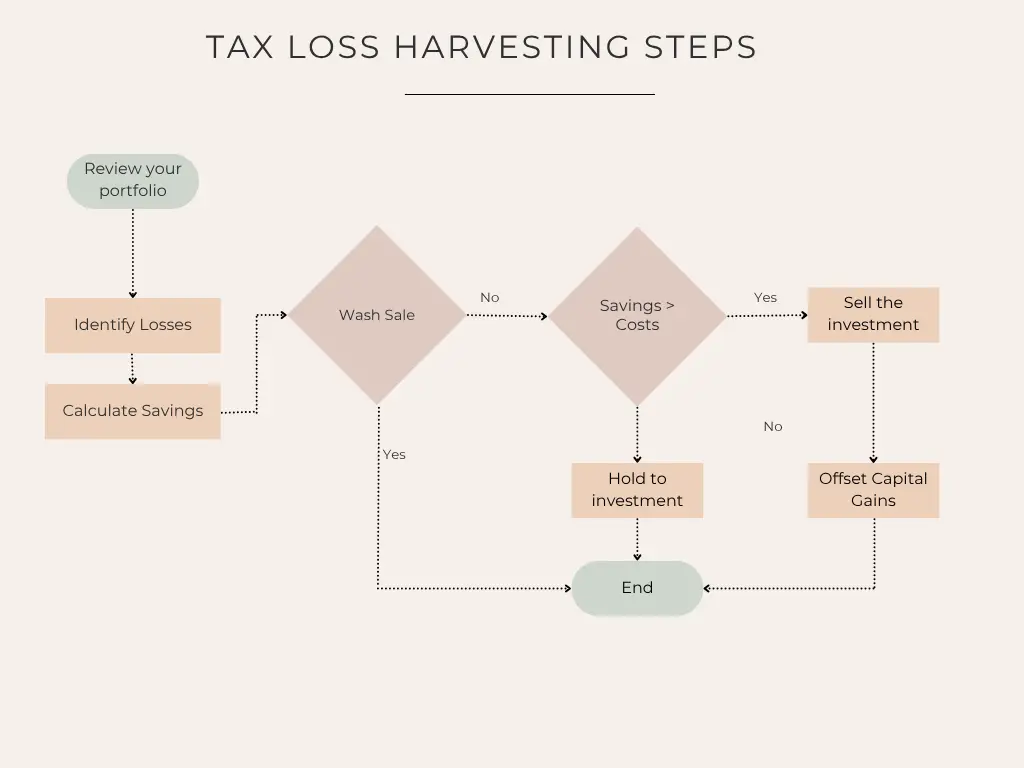
- Identify Investments with Losses: Review your portfolio for assets worth less than their purchase price. Focus on those you’re comfortable selling long-term.
- Calculate Potential Tax Savings: Estimate the tax benefit by multiplying the loss by your capital gains tax rate.
- Check for the Wash Sale Rule: Ensure you don’t plan to repurchase the same asset within 30 days, as this would negate the tax benefit.
- Evaluate Costs vs. Savings: Confirm that the tax savings outweigh any selling fees or transaction costs.
- Sell the Investment: Execute the sale to lock in the loss.
- Offset Capital Gains: Use the loss to reduce taxable gains or, if applicable, offset up to $3,000 of ordinary income.
By following these steps, you can make tax-efficient decisions that align with your broader financial plan for 2025 tax changes. For a more detailed breakdown, refer to the later in this post. This strategy not only helps you navigate the new tax landscape but also keeps your portfolio on track for long-term growth.
5. Revisit Your Estate Plan
Estate tax rules have also changed in 2025, with the exemption amount decreasing to $10 million from $12 million. This means more estates could be subject to taxes. To adjust your financial plan for 2025 tax changes, consider setting up a living trust or making annual gifts of up to $18,000 per person to reduce your taxable estate. A living trust can also help your heirs avoid probate and maintain privacy. For a deeper dive, check out our Guide to Estate Planning.
Conclusion
The 2025 tax changes present both challenges and opportunities. By understanding the new rules and adjusting your financial plan accordingly, you can minimize your tax burden and stay on track to meet your goals. Whether it’s maximizing retirement contributions, leveraging tax-advantaged accounts, or revisiting your estate plan, these strategies will help you navigate the changes with confidence. Remember, financial planning for 2025 tax changes is an ongoing process—consult a financial professional for personalized advice.